


Key takeaways
- Upstart is a borrowing platform powered by AI underwriting which looks at more than 2,500 variables¹³ to see beyond the traditional credit score.
- Borrowers with thin credit files, gig income, or non-traditional backgrounds may qualify where traditional lenders decline them.
- The Upstart model approves 41.40% more applicants in aggregate as compared to a traditional model, and results in APRs that are 33.10% lower3.
Loans through Upstart are underwritten by an advanced AI model that weighs more than 2,500 variables¹³, including employment history and education², to see far beyond a credit score alone. If you have been declined before, or if you have strong credit and think a broader review could help you, Upstart’s approach may be good for you.
Here’s how Upstart works, what to expect in the application process, and what to look for in an offer before you accept it.
How the Upstart Lending Platform Works
Through Upstart, you could borrow $1,000 to $75,0005 with a 3-year or 5-year term, and APRs ranging from 6.3% to 35.99% 7. There currently is no co-signer option, so you qualify based on your own unique profile.
Upstart’s AI-powered underwriting model is designed to make the borrowing process smooth and straightforward. This technology allows the platform to return decisions quickly and, if approved, fund loans as fast as one business day¹⁵.
What loan options are available through Upstart
Personal loans are Upstart’s flagship product, but the product line continues to expand. Upstart now offers Cash LineTM—a revolving line of credit, and short-term relief loans for borrowers who need smaller amounts or faster repayment timelines.
For homeowners, Upstart Home Lending provides home equity lines of credit (HELOCs).
How Upstart Differs from Traditional Models and Other Online Lenders
Understanding how Upstart fits into the current lending landscape requires looking at how its model distinguishes itself from both traditional models and other online lending platforms.
Upstart vs traditional lending:
- Underwriting inputs. Traditional lending primarily weighs your FICO score, income, and debt-to-income ratio. Upstart’s model evaluates 2,500+ variables¹³, including employment tenure, education2, area of study, gig income, and the cost of living where you live.
- Credit score flexibility. Traditional lending enforced a minimum credit score. There is no fixed minimum credit score through Upstart in most states, so a lower score is one input rather than an automatic gate.
- Speed. A traditional loan can take days to weeks from application to funding. Funds through Upstart may arrive in as little as one business day after approval¹⁵.
- Application process. Traditional lending often routed you to a branch or a loan officer. Upstart runs its process fully online from rate check to funding.
- Decision objectivity. Upstart’s model evaluates applications algorithmically rather than through a loan officer’s judgment, which can vary by individual. ~91% of loans through Upstart are evaluated automatically without human intervention.14This removes the subjective human step from underwriting. It does not eliminate all bias, but it takes one variable out of the equation.
Upstart vs other online lenders or lending platforms
Many fintech lenders require a minimum credit score. According to NerdWallet and Bankrate, some competitors require 600 to 750 or higher to qualify. Upstart does not set a minimum. Its variable set is also broader than most online lenders, which rely on FICO plus income verification alone, because it includes factors such as education, employment trajectory, gig income, and local cost of living.
| Traditional lending | Typical online lender | Upstart | |
| Underwriting inputs | Primarily FICO + income/DTI | Primarily FICO + income | 2,500+ variables¹³ incl. employment, education2, gig income, spending habits |
| Min. credit score | Typically 670+ | Often 600+* | Has no min. Credit score in most states |
| Income types | Typically W2 only | Typically W2 + some 1099 | W2, gig, freelance |
| Decision speed | Typically Days to weeks | Typically 1–3 days | As fast as 1 business day¹⁵ |
| Decision process | Loan officer review | Algorithm | Algorithm |
Examples are for illustration only. Actual rate, term, and savings will vary based on your credit profile and lender.
How Upstart’s AI Model Evaluates Your Application
Here are variables Upstart’s AI-powered underwriting model may look at:
Employment and income stability
The model uses data such as current income, employment status, and length of tenure to evaluate earning patterns.
Education and professional background
Highest degree, area of study, and institution may be weighed. Education² is not a minimum requirement. A degree is not required to qualify, and is just one of many signals the model may consider.
Spending and saving habits
Spending and saving habits, such as consistent saving, may signal how well you manage money.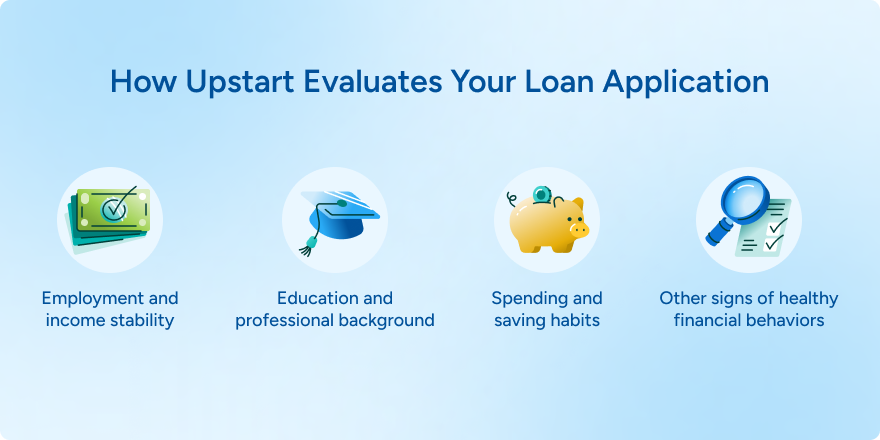
Impact of AI-powered underwriting model
These indicators help create a broader view of your financial responsibility.
By looking beyond traditional credit scores, the Upstart model approves 41.40% more applicants in aggregate as compared to a traditional model, and results in APRs that are 33.10% lower3.
Borrowers Who May Benefit From Upstart’s Underwriting
Good or excellent credit borrowers
Because employment trajectory and income stability factor directly into risk pricing, the Upstart model looks at a fuller picture which would generate for the same applicant. There is no set minimum credit score in most states, so every profile is evaluated on its full picture.
Non-traditional employment background
Being early in your career or returning to the workforce does not automatically disqualify you. The model may weigh your current trajectory or future potential rather than only your past.
Thin credit file
Limited accounts or a short history can make lenders cautious. Upstart’s model evaluates employment trajectory and financial habits, which may offset a thin file.
Fair or lower credit score
Past credit issues that a traditional score treats as a penalty may be weighed differently by a model that also reads details like income stability and employment. You may qualify where a score cutoff would have otherwise stopped you.
Gig or freelance workers
Upstart accepts non-W2 income, so a rideshare driver or contract designer with a steady earnings history could qualify without traditional pay stubs.
Recent graduates
A degree paired with a new job may help even with a limited credit history, so a recent STEM graduate starting a first salaried role might receive an offer that most lender would not extend.
People declined elsewhere
A prior rejection does not automatically project your outcome through Upstart. The model reads different signals and may reach a different conclusion.
How to Apply for a Loan Through Upstart
Applying for a loan and receiving funds through Upstart follows 4 steps, from initial rate check to funding. See below for the Upstart process, explained:
- Check your rate: Go to Upstart.com and enter your desired loan amount plus some basic personal information. This runs a soft pull only and does not affect your credit score1. You can check your rate at Upstart.com in a few minutes.
- See your options: If approved, you will see your APR, estimated monthly payment, origination fee if any, and term options of 3 or 5 years⁷. There is no commitment at this stage.
- Get your funds: Here you verify your income and employment and upload supporting documents such as pay stubs or bank statements. If you are approved and you accept the offer, funds may arrive as soon as one business day¹⁵ after verification is complete.
What to Look for in Your Upstart Loan Offer
Reviewing your offer closely provides clarity on the loan’s total cost, helping you understand the details before making a decision that’s right for you. Upstart ensures terms are clear and transparent so they’re easy to understand.
A few numbers determine the total cost of the loan.
Understanding APR
Your APR is the total annual cost of the loan including most fees (such as origination fees), not just the interest rate.
Origination fees
Origination fees can range from 0% to 12% and are deducted upfront from your principal. If you borrow $10,000 with a 5% fee, you receive $9,500 but repay the full $10,000 with interest.
Monthly payments and terms
Your monthly payment is a fixed amount, so confirm that it fits your budget before accepting. Your loan term have options of 3 or 5 years⁷, allowing you to make a trade-off: a longer term means a lower monthly payment but more total interest over the life of the loan. What works best will be personal to you.
Prepayment penalty
Through Upstart, there is no prepayment penalty, so you can pay your loan off at any time, at no extra cost.
Frequently Asked Questions
How does Upstart’s AI model decide who gets approved for a loan?
The model evaluates more than 2,500 variables¹³ and predicts the probability of default. Beyond credit history, it may consider income, employment tenure, education², geographic cost of living, and gig income. No single factor decides the outcome on its own.
Does Upstart do a hard credit pull when you apply?
Checking your rate uses a soft credit pull only, which does not affect your credit score1. A hard inquiry happens if you proceed to a formal application after reviewing your offer. That hard pull typically lowers your score by a few points.
How does Upstart’s AI model learn and improve over time?
As of 3/31/2026, the model was trained on 110 million monthly repayment events and receives approximately 124,800* new repayments daily. It updates continuously from real loan outcomes rather than a static algorithm. This means it refines its risk assessment based on how actual borrowers repay, always getting smarter and more accurate..
Can I get a personal loan through Upstart with fair or bad credit?
You may qualify with fair or lower credit because Upstart does not set a minimum credit score in most states and weighs factors beyond your score. The model reads income stability, employment, and financial habits alongside credit history. Approval and rate are not guaranteed and depend on your full profile.
Does Upstart accept gig, freelance, or self-employed income?
Upstart accepts gig, freelance, and self-employed income, where traditional lending has relied on W2 pay stubs. The model can factor non-W2 earnings into its evaluation. You still need to verify that income with bank statements or other documents during the application.
Does Upstart consider your education or job history when approving loans?
The model may consider education² level, area of study, institution, and length of employment as signals among more than 2,500 variables¹³. Education is not a minimum eligibility requirement, and a degree is not required to qualify. These signals are weighed alongside credit and income, not in place of them.
Does Upstart offer competitive rates for borrowers with good or excellent credit?
Borrowers with good or excellent credit may receive competitive rates because the model prices risk more precisely. Employment trajectory and income stability factor directly into that pricing. Rates range from 6.3% to 35.99% APR⁷, and your specific offer depends on your full profile, so a competitive rate is not guaranteed.




 Won't affect your credit score¹