
Asking for Help Isn’t a Weakness. It’s a Financial Strategy

By Upstart Content Team | Updated October 27, 2025
reading time 4 min read

Key takeaways

  • 67% of U.S. adults say it’s time to erase the stigma around asking for financial support—an important step in reducing financial stress.
  • Millennials (71%) and Gen Z (66%) are most likely to seek financial guidance to reach their goals.
  • 81% say their financial institutions could do more to understand them, and 72% believe better financial support would improve mental health and financial decision-making.

The truth about money in 2025

Let’s be honest—money can be stressful. We’ve all had moments when we needed a little bit of help but felt too afraid to ask. Or maybe you didn’t know who to ask? You’re not alone. Whether it’s splitting the bill, managing an unexpected expense, or figuring out how to make ends meet, many of us have been taught that needing support means we’ve somehow fallen short. But what if it didn’t?

New research reveals a shift

A new survey* conducted by Talker Research on behalf of Upstart shows that Americans are rewriting the story around asking for support. Across generations, 67% of people agree it’s time to erase the negative stigma around asking for help. The survey also reveals that as financial pressures grow, many believe stronger guidance from financial institutions could boost both confidence and overall well-being.
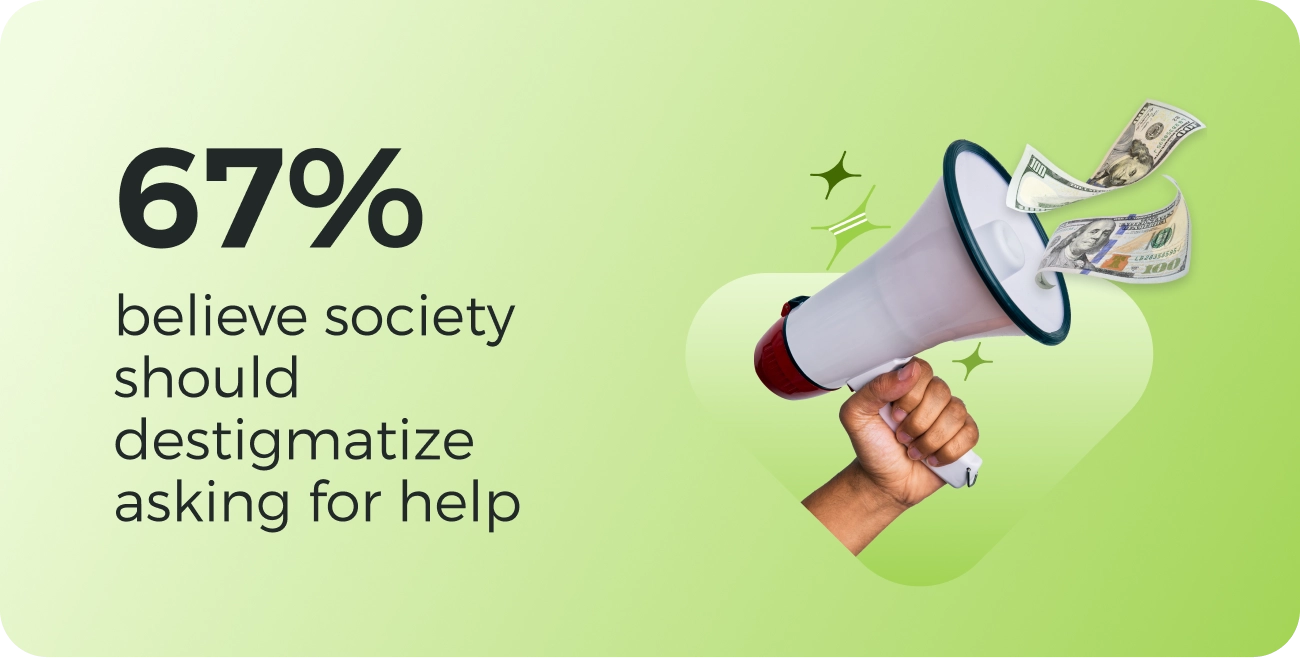
67% believe society should destigmatize asking for financial help

Younger adults are normalizing the conversation, seeing financial support as something to embrace—not hide. While only 54% of Gen X and 45% of Boomers see asking for help as a positive, that changes with younger groups: 66% of Gen Z and 71% of Millennials view it as a powerful strategy for reaching their goals. With attitudes towards money evolving, reaching out for guidance is becoming recognized as a practical, even strategic, approach to financial challenges. Many even shared how they think we could destigmatize asking for help: 

One correspondent said, “[We should make] people feel like it’s OK to ask for help. In doing this, it would empower people to find the resources they need in order to help themselves and others.” 

Financial stress in statistics

Money touches nearly every part of our life—and for many, it’s the biggest source of stress. 87% of Americans say finances add to their anxiety most often from living paycheck to paycheck (41%), handling unexpected costs (23%), managing high-interest debt (13%), or feeling a lack of support (12%). 
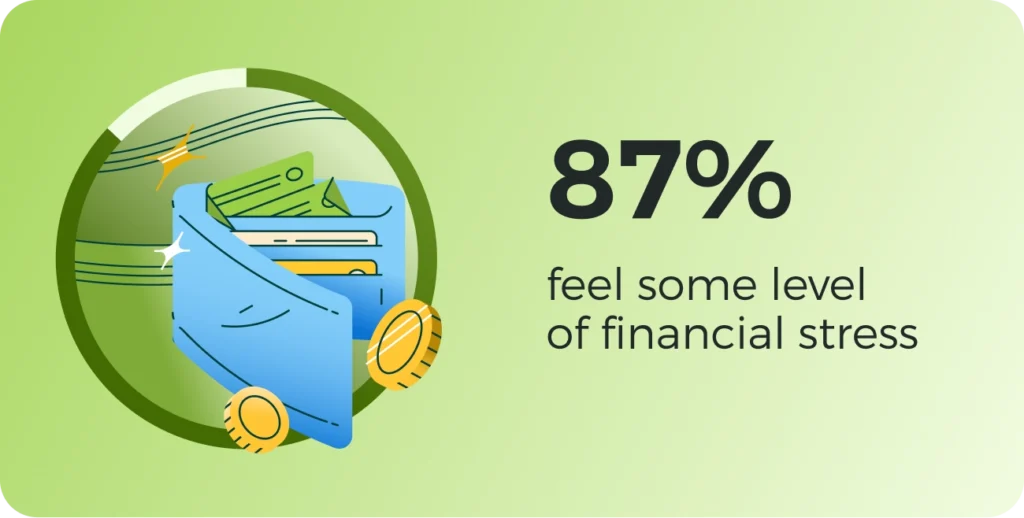
87% feel some level of financial stress

Even more telling? 81% of people say their financial institutions could be doing more to help. “Getting the right financial support is a major unlock for most Americans,” said Chantal Rapport, Chief Marketing Officer at Upstart. “So much of our lives are tied to our financial situations, so when people are understood and supported by trustworthy financial partners, they can focus on what matters and go on to do great things in their lives and their communities.”

Americans call for better financial support

Better financial support could make a real difference. 72% believe that better financial support would have a major positive impact on their mental wellbeing. Two-thirds also say it would actually increase their confidence when making financial decisions. 
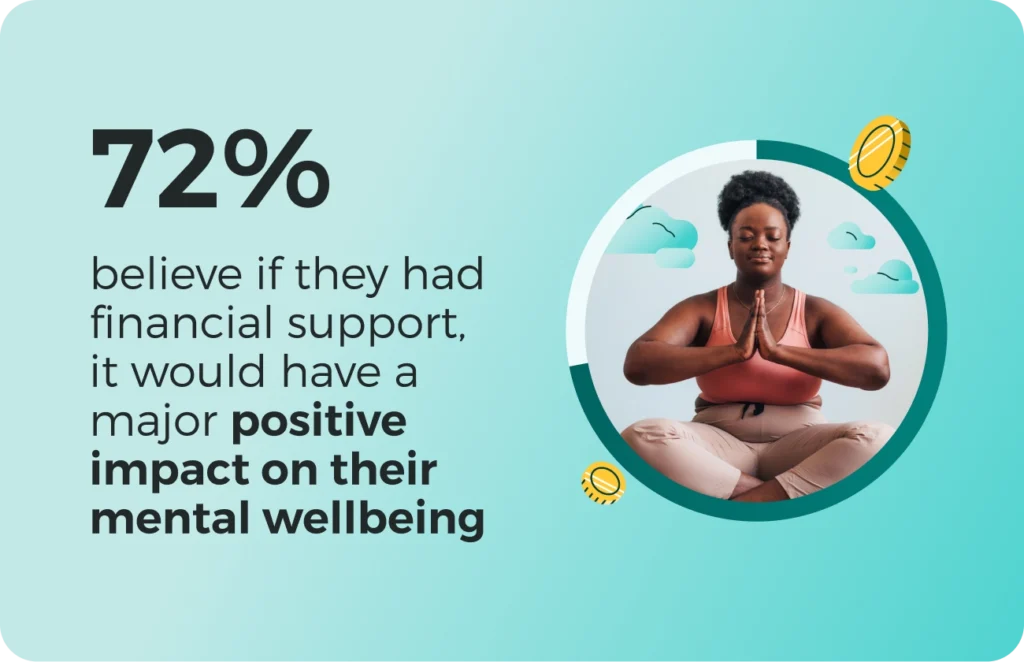
72% believe financial support would have positive impact on mental wellbeing

When people have access to the right tools, they can build momentum toward their goals. “It’s natural for people to feel this internal struggle when it comes to asking for help, but this survey shows that the stigma is slowly fading away,” said Erin Opperman, Vice President of Creative at Upstart. “No one should feel like they’re being judged simply because they could use a little extra support. Having systems in place to help people progress is how we grow together as a society.”

Financial support that builds confidence

Asking for help isn’t about falling behind—it’s about moving forward with confidence. More and more people are realizing that reaching out for support isn’t a weakness, it’s a strength. At Upstart, we believe that everyone deserves access to financial support that empowers them—without judgement. Because when people feel understood and encouraged, they don’t just change their finances, they change their futures. apply for personal loan

*Survey Methodology: Talker Research surveyed 2,000 American adults, split evenly by generation (Gen Z, Millennial, Gen X, and Baby Boomer). The survey was commissioned by Upstart and conducted online by Talker Research between September 30 and October 6, 2025. Results are based on self-reported responses and are not intended to represent all consumers.


Frequently Asked Questions

Q1. Why is asking for financial help a smart strategy?

It’s increasingly seen as a practical way to handle money challenges—not a shortcoming—especially among younger adults.

Q2. How does support affect stress and well-being?

72% of Americans believe that better financial support would reduce stress and have a positive impact on mental well-being.

Q3. Can support improve confidence in money decisions?

Yes—most respondents say that with more support from financial institutions, they’d feel more confident making financial decisions.

Q4. What keeps people from asking for help?

Stigma. Many believe we should erase the negativity around asking for help so people can more easily access resources.


upstart logo

About the Author

Upstart Content Team

The Upstart Content Team develops educational content grounded in research and real-world financial experiences. By breaking down complex topics into clear, actionable insights, the team helps readers navigate important decisions—so they can feel confident in the money moments that matter.

More resources you may be interested in

Refinance a Personal Loan? How and When To Do It
Secured vs. Unsecured Loans: Which Is Right for You?
Personal Lines of Credit: Should or Shouldn’t You?
The 6 Biggest Misconceptions About Money

See if Upstart is right for you

Check your rate lock Won't affect your credit score¹

Upstart Network, Inc. (NMLS #936133) is not a lender. All loans on its marketplace are made by regulated financial institutions.

All mortgage lending is conducted by Upstart Mortgage, LLC dba Upstart Home Lending. (NMLS #2443873). Equal Housing Opportunity.

  1. Checking your rate won’t affect your credit score: When you check your rate, we check your credit report. This initial (soft) inquiry will not affect your credit score. If you accept your rate and proceed with your application, we do another (hard) credit inquiry that will impact your credit score. If you take out a loan, repayment information may be reported to the credit bureaus.
  2. Upstart’s model considers education: Neither Upstart nor its lending partners have a minimum educational attainment requirement in order to be eligible for a loan.
  3. 41% more approvals and 33% lower rates than a traditional model: As of publication in April 2026, and based on a comparison between the Upstart model and a hypothetical traditional model using Upstart data from Jan – Dec 2025. For more information on the methodology behind this study, please see Upstart’s Annual Access to Credit results here.
  4. Unsecured Loans: While most loans through Upstart are unsecured, certain lenders may place a lien on other accounts you hold with the same institution. There may be an option to secure your personal loan through Upstart with your vehicle, which will require a lien to be placed on the vehicle. It is important to review your promissory note for these details before accepting your loan.
  5. Loan amounts from $1,000 -$75,000: Your loan amount will be determined based on your credit, income, and certain other information provided in your loan application. Not all applicants will qualify for the full amount. Minimum loan amounts vary by state: GA ($3,100), HI ($1,500), MA ($7,000). Maximum loan amounts may vary by state.
  6. Closing and funding timeline: In April 2026, 10% of funded HELOCs achieved a closing timeline of 2 days or less and a funding timeline of 7 days or less. This timeline assumes consumers close with our remote online notary, provide supporting documentation promptly, and ensure the information provided is accurate and consistent with our verification process. Delays, discrepancies, and other unforeseen factors may impact the closing timeline. MBA’s 2025 Home Lending Study reports an average industry closing time of 37 days.
  7. APRs from 6.2% – 35.99%, with 3 or 5 year terms: The full range of available rates varies by state. The lowest rates are only available to the most qualified applicants. A representative example of payment terms for an unsecured Personal Loan is as follows: a borrower receives a loan of $10,000 for a term of 60 months, with an interest rate of 17.50% and a 7.25% origination fee of $725, for an APR of 21.23%. In this example, the borrower will receive $9275 and will make 60 monthly payments of $252. APR is calculated based on 5-year rates offered in March 2026. There is no downpayment and no prepayment penalty. Your APR will be determined based on your credit, income, and certain other information provided in your loan application. Not all applicants will be approved.
  8. Instant deposits: To receive instant funding, your bank account must support instant transfers. If your account does not support instant transfers, funds will be available to you depending on your bank’s transaction processing time and policies.
  9. Always On Commitment: We are committed to maintaining your credit limit as long as you continue to meet program eligibility and account requirements. To ensure the safety and security of all our members, we reserve the right to adjust or close lines in specific circumstances, including account default or late payments, suspected fraud, violation of our terms of service (including abusive behavior), or when necessitated by legal or regulatory requirements.
  10. Cash Line draws: You may request a draw at any time. Only one draw may be outstanding at a time; after it is fully repaid, you may request another.
  11. HELOC APRs as low as 6.52%: Terms shown here are subject to change without notice. APRs for initial advances range from 6.52% to 18.00% based on rates offered as of April 2026. The lowest rate is only available to consumers willing to become a member of a credit union and to those who meet a minimum FICO score of 780, CLTV under 70%, and DTI under 45%. Your actual rate will depend on many factors such as your credit history, combined loan-to-value ratio (CLTV), line amount, loan term, lien position, and property state. Origination fee to open an account is between 0% and 4.99% of the approved credit limit. The Annual Percentage Rate (“APR”) is variable and based on the Prime Rate as published in the Wall Street Journal “Money Rates” table plus or minus a margin. Your APR will never be less than 3.99% or greater than 18.00%. Property insurance is required.
  12. No annual fee, prepayment penalty, or fees to redraw: Terms shown here are subject to change without notice. Origination fee to open an account is between 0% and 4.99% of the approved credit limit. The Annual Percentage Rate (“APR”) is variable and based on the Prime Rate as published in the Wall Street Journal “Money Rates” table plus or minus a margin. Your APR will never be less than 3.99% or greater than 18.00%. Property insurance is required.
  13. 2,500+ Variables:As of 3/31/2026. “Variables,” often also referred to as “features,” refers to raw variables and combined variables considered in our AI models. A “raw” variable is a non-combined, conceptually distinct unit of data, such as “applicant-reported savings.” A “combined” variable is data that has been transformed, combined, or otherwise engineered from a raw variable or set of raw variables, such as “applicant-reported savings” divided by “loan amount.
  14. Fully automated loans: In Q2 2026. Percentage of Loans Fully Automated, which is defined as the total number of loans in a given period originated end-to-end (from initial rate request to final funding for personal loans and small dollar loans, and from initial rate request to signing of the loan agreement for auto loans) with no human involvement required by the Company divided by the Transaction Volume, Number of Loans in the same period.