
New Upstart research reveals three patterns shaping Americans’ financial lives, from everyday spending pressures to the gap between feeling better off and making it to payday.
A grocery run that costs more than you planned. A stretch before payday when the money doesn’t quite last. A credit card balance you hope to bring down before the holidays arrive.
Financial pressure doesn’t always come from a major expense. Sometimes, it’s the everyday costs and the timing of them that make a budget feel tight.
To better understand those experiences, Upstart surveyed 1,000 U.S. adults about their spending, cash shortfalls and financial outlook. Their responses showed that essentials are stretching budgets, younger respondents can feel optimistic while still running short, and many Americans are hoping to pay down debt before another demanding season begins.
Here are three patterns that stood out.
1. The Optimism Gap
Feeling better about your finances doesn’t always mean having enough to make it to payday.
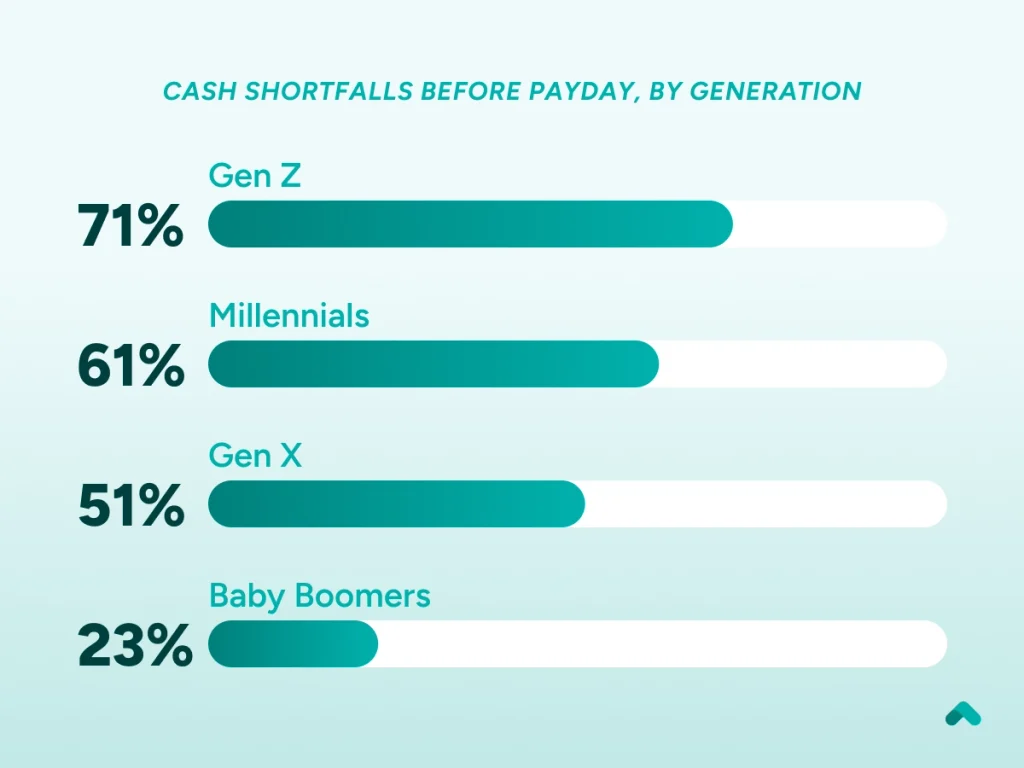
Nearly half of respondents (48%) said they had come up short before payday at least once in the past six months. That experience was especially common among younger generations: 71% of Gen Z and 61% of Millennials reported a shortfall, compared with 51% of Gen X and 23% of Baby Boomers.
For many, the typical gap was a few hundred dollars. Among respondents who had come up short, 36% said they were typically $100 to $249 short, and 26% reported a gap of $250 to $499. Among respondents who had come up short, 20% turned first to family or friends to cover the gap, another 20% used savings, and 18% turned to credit cards.
Yet younger respondents were also the most likely to report improvement. Forty-five percent of Gen Z said their household’s financial situation was better than a year ago, compared with 32% of Millennials, 16% of Gen X and 14% of Boomers.
That contrast shows the complexity of Gen Z’s financial lives: the generation most likely to have run short before payday is also the most likely to say its finances have improved.
The ways people cover those gaps also differ. Among Gen Z respondents who had come up short, 26% turned first to family or friends, and 19% turned to a cash advance app. Just 13% turned first to savings, compared with 29% of Boomers who experienced a shortfall.
For younger respondents, the picture includes both signs of progress and the practical challenge of making money last between paydays.
2. The Essentials Squeeze
This year, summer overspending was more often about groceries and gas than getaways.
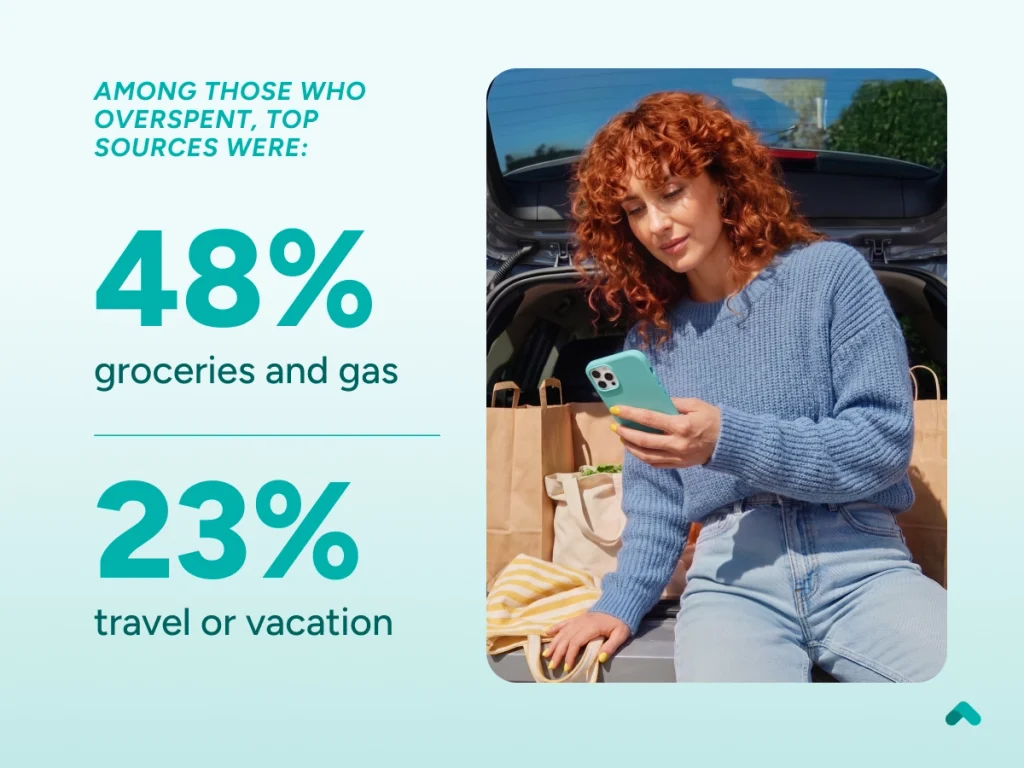
Thirty-five percent of respondents said they spent more than planned this summer, excluding mortgage and rent payments. Among that group, 48% identified groceries and gas as the category they overspent on most—more than twice the share who selected travel or vacation, at 23%.
The amounts weren’t always small. Among those who overspent, 25% went $500 to $999 over budget, while another 24% went $1,000 to $2,499 over.
And that pressure extends beyond summer. When asked what was putting the most pressure on their budget right now, 40% of all respondents selected prices for groceries and essentials. That was well ahead of income not keeping up, at 14%, and housing costs, at 12%.
New credit card balances were also more common among those who went over budget.
Forty-nine percent of summer overspenders were carrying a balance they hadn’t been carrying in May, compared with 23% of those who spent about what they planned and 23% of those who spent less.
Going beyond a planned budget doesn’t necessarily mean a splurge. For many respondents, it meant spending more than expected on everyday needs.
3. The Holiday Catch-Up
The holidays are approaching, but some respondents are still managing credit card balances they weren’t carrying before summer.
Thirty-two percent of respondents said they were carrying a credit card balance they hadn’t been carrying in May.
Those new balances were more common among younger Americans: 41% of Millennials and 40% of Gen Z reported carrying a balance they hadn’t been carrying in May, compared with 32% of Gen X and 22% of Boomers.
Among respondents with those new balances, 78% had set a goal to pay down the debt before the upcoming holiday season. Their expectations were more measured: only 53% said they definitely or probably would pay it down before the holidays.
Setting a goal also took different forms. Forty-three percent of respondents with new debt had a specific amount and target date in mind, while 35% had a general goal without a specific plan.
Meanwhile, the winter holidays ranked as the most financially stressful season for 59% of Gen X and 55% of Boomers. Gen Z’s seasonal pressure looked different: summer narrowly led at 38%, compared with 34% who selected the winter holidays.
The calendar brings different pressures to different generations and households. For many Americans, this fall includes both a desire to reduce existing debt and the prospect of another expensive season ahead.
Understanding the reality behind the numbers
Across the findings, Americans’ financial lives resist a simple label. Spending more than planned can mean buying essentials. Feeling better off can coexist with running short. Wanting to reduce debt can come with uncertainty about when it will happen.
At Upstart, “Money for the Moments That Matter” starts with understanding the financial realities surrounding those moments, including the everyday ones. This survey of U.S. adults helps us better understand Americans’ financial lives.
Media Contact: Michael.Kaye@Upstart.com
Methodology: Upstart surveyed 1,000 U.S. adults ages 18 and older recruited online through QuestionPro panel partners. The sample was quota-balanced to census demographics. The survey was fielded from September 23–October 5, 2026. This survey reflects respondents’ perspectives and should not be interpreted as an indication of seasonal trends in Upstart’s business.. Generational sample sizes were 99 for Gen Z (born 1997 to 2008), 309 for Millennials (born 1981 to 1996), 306 for Gen X (born 1965 to 1980) and 272 for Baby Boomers (born 1946 to 1964). Summer overspending findings are based on 347 respondents; shortfall amounts and coping methods are based on 481 respondents who had come up short; debt-paydown findings are based on 323 respondents carrying a credit card balance they weren’t carrying in May. Percentages are rounded.